This is the interface the skill's own drafts render into - built once reading them by hand got old, not required to read them at all.
Your agent drafts it. Your storage holds it. Your token posts it - all three already yours, nothing here asking for an account.
read https://dev.review/install and follow it
Any skill that writes the draft file works here. This is the one we already wrote.
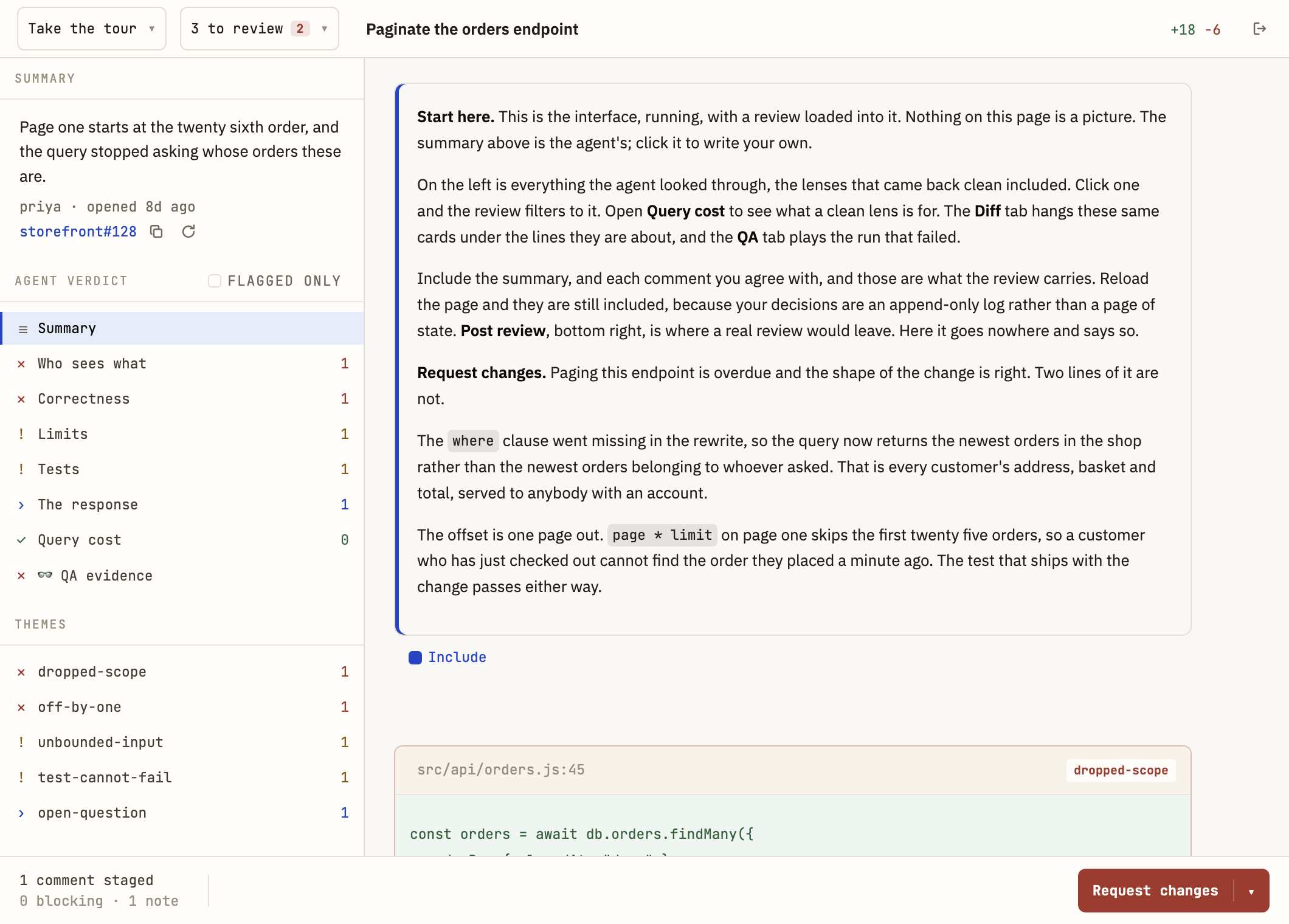
A draft is one JSON file, so you can digest it any way you like: in your editor, or driven from a skill that never leaves the terminal. We've built a client that does it better than either - forty findings anchored beside the lines they are about beats forty findings held in your head against a diff. This is a screenshot of that build, open on a real review of a real commit in the repository that renders it. Nothing here is staged for the picture.
This is the interface the skill's own drafts render into - built once reading them by hand got old, not required to read them at all.
Some systems will always require full human eyes on every change. That is a property of the systems, not a gap in the tooling, so it does not expire as agents improve. Eyes cannot land on a change they cannot see.
Attention is finite. Seeing more than you can act on is not seeing, it is noise. Look with attention proportional to the change, and act on what you find without leaving the page.
A tool that owns the agent, the storage and the host makes your seeing contingent on that vendor. Bring whatever review agent you like. Keep your files wherever you keep them. Leave without losing anything.
Every pull request waiting on you is drafted before you open this. The agent writes one JSON file into storage you already own. There is no API, no upload and no notification: the app asks your git host which pull requests await your review, derives the filename for each, and reads it.
Every lens is shown, including the clean ones, each with a line on what was actually checked. A lens with nothing flagged is the most useful thing on the page: it is the difference between checked and clean, and not looked at.
QA evidence shows the change was driven, not only read. The reviewer is the accountable party, so the reviewer decides what goes out.
Any agent. Any storage. Any host.
The whole integration is a JSON file on disk, published and versioned, so anything that can write that file can feed this interface. Nothing here is coupled to one generator, one storage backend or one git host.
The bundled vendors cannot take this position, because each of them wants to own generation and the reading surface together. Neutrality is not only a principle here. The systems you are responsible for rarely all live in one place, so a tool tied to one host fails the first want by construction.